
 Each year
artists are encouraged to submit applications to Sprout Public Art in hopes of being selected to share their artistic vision by
completing a mural in a local community. Eligible artists must reside in the Western Pennsylvania region
which includes Allegheny, Armstrong, Beaver, Bedford, Cambria, Fayette, Greene, Indiana, Lawrence, Mercer,
Somerset, Washington and Westmoreland counties. The guidelines of the Sprout Public Art project state,
“Artists that are chosen as final muralists by the communities are paid competitive artist fees determined
by the size of the mural. All supplies, materials and design and artist fees are provided by Sprout Public
Art and murals are provided at no financial cost to participating communities.”
Each year
artists are encouraged to submit applications to Sprout Public Art in hopes of being selected to share their artistic vision by
completing a mural in a local community. Eligible artists must reside in the Western Pennsylvania region
which includes Allegheny, Armstrong, Beaver, Bedford, Cambria, Fayette, Greene, Indiana, Lawrence, Mercer,
Somerset, Washington and Westmoreland counties. The guidelines of the Sprout Public Art project state,
“Artists that are chosen as final muralists by the communities are paid competitive artist fees determined
by the size of the mural. All supplies, materials and design and artist fees are provided by Sprout Public
Art and murals are provided at no financial cost to participating communities.”
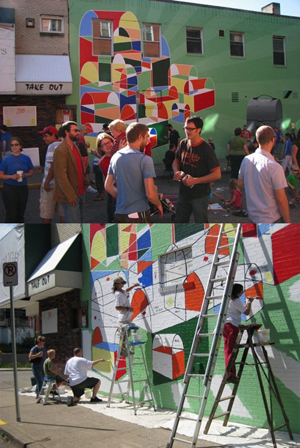 “The first
comment out of everyone’s mouth is usually, I’m so happy we’re finally going to cover up this run-down
wall with something pretty!” Taylor Shields, a graduate of Carnegie Mellon University’s Fine Arts
program, was one of the artists selected to participate in this year’s Sprout Public Art project. She speaks
for “Dormont: 100 Years Young,” a spiritually enticing mural which spans across the wall of the Antique
Exchange at 2938 West Liberty Avenue. “Dormont is interesting because it’s a historic neighborhood with a
lot of pride but it is also experiencing a kind of renewal . . . as the city expands; Dormont is changing
and featuring different age groups, business types, community interests, etc. I wanted to stress the history
while also keeping the focus on the future—so Dormont is viewed as 100 years young instead of 100
years old.”
“The first
comment out of everyone’s mouth is usually, I’m so happy we’re finally going to cover up this run-down
wall with something pretty!” Taylor Shields, a graduate of Carnegie Mellon University’s Fine Arts
program, was one of the artists selected to participate in this year’s Sprout Public Art project. She speaks
for “Dormont: 100 Years Young,” a spiritually enticing mural which spans across the wall of the Antique
Exchange at 2938 West Liberty Avenue. “Dormont is interesting because it’s a historic neighborhood with a
lot of pride but it is also experiencing a kind of renewal . . . as the city expands; Dormont is changing
and featuring different age groups, business types, community interests, etc. I wanted to stress the history
while also keeping the focus on the future—so Dormont is viewed as 100 years young instead of 100
years old.”
Dormont is one of eight neighborhoods Sprout Public Art has selected for “visual landscape enhancement,” a.k.a. building-size murals which not only showcase qualities of the targeted neighborhood, but hope also to inspire passersby. Since 2003, Sprout has been awarding grants to communities in an attempt to strengthen the bond between the communal spirit and the flourishing public artist—something which has resulted in the astonishing development of over 45 enriching works of public art. In an attempt to bridge the disconnect between community members and urban landscapes within Pittsburgh, Sprout has funded artists like Shields who, when asked to express her own experience, replies, “The community has been great! Everyone is so excited about the mural and has given interesting input. When I’m painting, many people stop to ask questions or voice their support. It really makes a difference to know that the community is so invested in this project, and it makes the value of Sprout’s organization extremely clear.”
Jeffrey Schrekengost, a graphic designer who has lived in Pittsburgh since 1987, enjoyed both the experience and challenge in developing a hand-painted mural in the small business district of Morningside.
“It was a really rewarding experience. Most of the time when doing artwork and music, I deal with the same groups of people—they know what to expect from me and I know what most people want when they request a piece of art for a project. The subject matter of my work is usually strange since I’ve been obsessed with horror and sci-fi movies since I was a kid. Working with this community was quite a different experience for me. Doing a large public art piece, I knew it wouldn’t/couldn’t be too strange. It was great to work with them—creating an image that all of us would enjoy.”
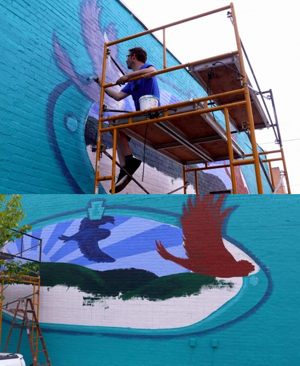 The title of
Schrekengost’s mural is “Good Morning” and can be found on the corner of Greenwodd and Chislett street on
the wall of a small, locally owned convenience store. The mural features large soaring birds (one blue and
one red) above a small sun-layered hilly village. According to Schrekengost, his original mural-design
involved three large garden gnomes riding zoo animals. “Three large garden gnomes riding zoo animals are a
hard match for any community, but they were still very interested in having me paint something.”
The title of
Schrekengost’s mural is “Good Morning” and can be found on the corner of Greenwodd and Chislett street on
the wall of a small, locally owned convenience store. The mural features large soaring birds (one blue and
one red) above a small sun-layered hilly village. According to Schrekengost, his original mural-design
involved three large garden gnomes riding zoo animals. “Three large garden gnomes riding zoo animals are a
hard match for any community, but they were still very interested in having me paint something.”
Garden gnomes aside, many residents of Morningside have since welcomed Schrekengost’s mural with much praise. “A compliment can go a long way and I hope the mural I’ve left behind compliments the town. After spending so much time there, Morningside is my new favorite Pittsburgh neighborhood!”
On Sept 16, numerous citizens of Greenfield, Pa gathered at the wall of the PNC bank on Murray Avenue to partake in the festivities surrounding the dedication of the neighborhood’s second Sprout Fund Mural. Western Pennsylvanian artist, Ian F. Thomas, was the man behind the 40 x 90 ft. mural which turned out to be a considerably vibrant community spectacle. Food and music-friendly events were organized by local volunteers from Connect Greenfield. Pittsburgh’s City Council President, Doug Shields, was just one of many guest speakers who crashed the party.
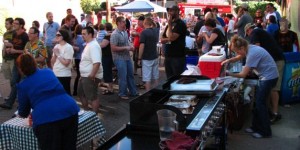
“Whether you’re new here or a life-long resident, we provide opportunities to get involved in your community.” Volunteers of Connect Greenfield effectively demonstrated their mission statement by providing performances by local musician, John Young, as well as a performance from “funk” rock band, Argyll’s Revenge. Sprout’s Public Art Program manager, Curt Gettman, also made an appearance at the unveiling of Thomas’ mural. Since joining the Sprout staff in May of 2007, Gettman has also co-founded the Pittsburgh-based Unicorn Mountain collective, which is a literary venue best known for its national distribution of anthologies featuring work from musicians, comic illustrators, painters, writers and screen print artists.
Thomas’ mural received heavy praise from Greenfield residents—some members of the community even stopped by to lend a hand during what was referred to as, “Community Painting Day.” Thomas is also known for his sculptures, paintings and ceramic works which often explore the stylized innocence of childhood imagination.
One thing is certain—it seems imagination is one element this year’s muralists have put to good use.
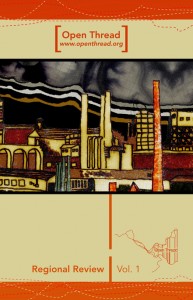 The open reading period for Volume Two of the Open Thread Regional Review closes
on Sunday, November 1st at midnight! We’re considering unsolicited poems, stories,
essays, paintings, drawings, prints, photos, video stills, documentation of 3-D work, comics, and mixed media
and genres!
The open reading period for Volume Two of the Open Thread Regional Review closes
on Sunday, November 1st at midnight! We’re considering unsolicited poems, stories,
essays, paintings, drawings, prints, photos, video stills, documentation of 3-D work, comics, and mixed media
and genres!
Who’s eligible? Any native or current resident of Open Thread’s target region: Ohio, Pennsylvania, and West Virginia. Eligible writers and artists must also be in the early stages of a career in their respective field.
Here’s how to submit: go to www.openthread.org, register as an Open Thread member (free!), and then upload your work at www.openthread.org/submit! Be sure to read carefully: preference is given to work that meets our submission guidelines.
The Open Thread Regional Review is an essential collection of the region’s best emerging art and literature. Volume Two is scheduled for release in early 2010 and is supported in part by a Seed Award from The Sprout Fund. Volume One is available for purchase at www.openthread.org/publications.
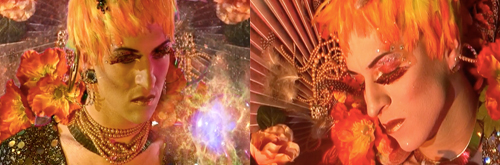 John
Musser, a.k.a. Veronica Bleaus, is a sassy, classy queen who you can find busting his sequined butt all over
Pittsburgh. A native of Crafton, PA and graduate of the University of
Pittsburgh, he volunteers for both the Pittsburgh AIDS Task
Force and the Gay
& Lesbian Community Center, in addition to performing and hosting at various events and benefits
across town, including a few for Open Thread. Recently, he’s been working with collaborator and previous
featured artist, Dani Lamorte, on a mission to bring the wonders for drag to the streets in a series of Drive-by Drag performances. Check out their site
frequently to find out where they will be performing next, as well as Veronica’s MySpace profile to see a bevy of photos from her previous escapades. I caught up with
John/Veronica recently, and I came with a few questions about living in Pittsburgh and his thoughts on drag.
Here’s what he had to say:
John
Musser, a.k.a. Veronica Bleaus, is a sassy, classy queen who you can find busting his sequined butt all over
Pittsburgh. A native of Crafton, PA and graduate of the University of
Pittsburgh, he volunteers for both the Pittsburgh AIDS Task
Force and the Gay
& Lesbian Community Center, in addition to performing and hosting at various events and benefits
across town, including a few for Open Thread. Recently, he’s been working with collaborator and previous
featured artist, Dani Lamorte, on a mission to bring the wonders for drag to the streets in a series of Drive-by Drag performances. Check out their site
frequently to find out where they will be performing next, as well as Veronica’s MySpace profile to see a bevy of photos from her previous escapades. I caught up with
John/Veronica recently, and I came with a few questions about living in Pittsburgh and his thoughts on drag.
Here’s what he had to say:
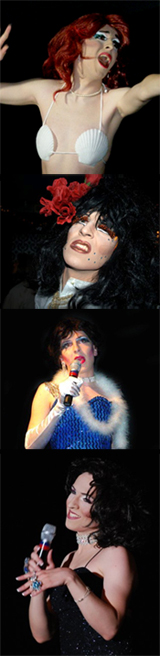 OT: Your
drag career started in 2004 when you came to the University of Pittsburgh to pursue your interests in
psychology and English literature. What got you into drag? Are there any moments from your childhood that
you look back on now and recognize as a build-up to your debut as Veronica Bleaus?
OT: Your
drag career started in 2004 when you came to the University of Pittsburgh to pursue your interests in
psychology and English literature. What got you into drag? Are there any moments from your childhood that
you look back on now and recognize as a build-up to your debut as Veronica Bleaus?
JM: More than anything else in my childhood, I suppose I would have to blame the birth of Veronica Bleaus on my enrollment into the University of Pittsburgh. Within a month of starting my freshman year, I was already hitting the coming-out process full swing. Several of my new friends were immersing me into aspects of gay culture, with which I was otherwise unfamiliar. The first seedlings of Veronica were planted when my friend Jess had decided to slather some makeup onto me on a Tuesday night. I decided that I should go in drag for Halloween and constructed a monstrosity of an outfit for myself, while relying on the kindness of women to paint their attempt at drag on my face. Even my name was bestowed upon me by others (in two parts and on two separate occasions). Veronica was not wholly a being of my own creation. I owe large portions of Veronica’s identity to the people who helped sculpt her; in some sense, Veronica has never really lost that feeling of mutability that helps her to adapt to so many different aesthetic representations. Subsequently, doing drag for yet another Halloween showed me that I made an attractive woman, and it at least gave me another reason to pursue this peculiarly wonderful hobby. Oddly enough, my childhood seems to have no moments that I can look back and say, “Veronica was here!” Even just months prior to my attending Pitt, I had thought that drag queens must be strange people, and I didn’t quite understand their place in the gay community. My mind was strewn with the mechanics of how drag queens would have sex; it wasn’t until I had actually seen my first drag show the summer before my Freshman year that drag suddenly made sense. It was nothing more than pure performance, illusion, fantasy, and fun. I was in awe.
OT: How has your conception of drag changed since you started performing? Are there any common misconceptions that you have noticed that you would like to dispel?
JM: I think, to a certain extent, that when a young queen begins to perform, she thinks that she must ‘pass’ as a woman. I was no exception. I initially evaluated the success of my looks based on how womanly I appeared. Thankfully, those days are over. The drive of young queens to look like real, slutty women, doing Top 40 numbers and performances, shows nothing about the real intricacies involved behind a well-crafted drag persona and production. I’m not saying that drag queens shouldn’t look feminine, or shouldn’t draw from a feminine aesthetic, but I’m rather suggesting that drag is more than just impersonation (while that is/can be a part of it). Drag is also camp, glamour, excess, inversion, wit, and frequently pain. The drag that is only as deep as illusion is about as shallow as a puddle. With that being said, drag does not have to impersonate; drag can create. Drag has and can create new aesthetics and new cultural amalgamations drawn from several aspects of both high art and pop culture. The Gender-F*ck look (i.e. queens who don’t shave, don’t wear wigs/tits/etc.), for example, has gone beyond traditional questions raised by drag, “what does it mean to be a woman?” and created several new ones, “what does it mean to be a drag queen/be in drag?” Also, consider the ways in which drag queens, almost effortlessly, cut and paste sounds from classic movies and songs to create a new, camp interpretation of a concept. I guess to summarize, drag is not just about looking like a woman.
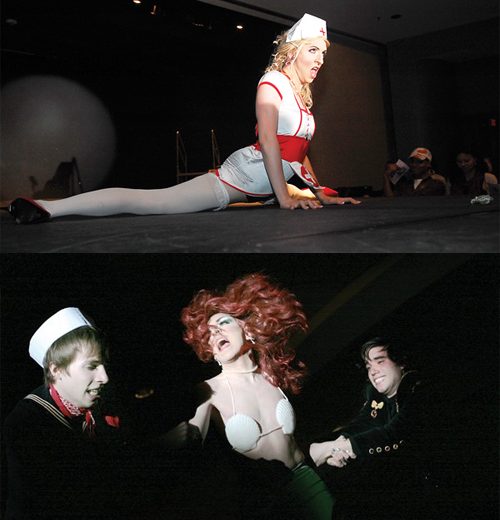 OT:
Veronica Bleaus’s style and attitude is one that borrows equally from classic Hollywood glamour and
contemporary pop culture, while referencing a rich history of drag performance. Where would you place
yourself within drag history? Are there any particular performers, cultural figures, or style icons that you
continually find yourself attracted to?
OT:
Veronica Bleaus’s style and attitude is one that borrows equally from classic Hollywood glamour and
contemporary pop culture, while referencing a rich history of drag performance. Where would you place
yourself within drag history? Are there any particular performers, cultural figures, or style icons that you
continually find yourself attracted to?
JM: What an astute description of Veronica! Consider me flattered. Within the grand scheme of drag culture/history, I’m insecure enough to say that I’m a chip off the old block, but insightful enough to understand that what I do isn’t exactly the same as the rest of the queen crowd. While I do borrow from the classic drag repertoire, like the standards of Liza and Judy, I have an equally special place in my heart for more modern drag fixtures like Hedwig and the Angry Inch and Kylie Minogue. I think there’s a part of Veronica that wants to be noticed by a greater audience than the audience that more traditional bar queens shoot for. If drag history had a page about me, I would like it to say that I helped to bring drag out of the bar and into the streets (hide your children!). I have a love of so many icons that have influenced my drag; these figures might not be the most famous or popular, but have somehow left marks on the way Veronica thinks and acts. Audrey Hepburn comes to mind, for her aversion to trends, opting instead for classic, classy, unequivocal glamour. Judy Garland for her humor and the way she never quite seemed afraid to laugh at herself amidst all of her insecurities; she is still a legend. And Kylie Minogue, it seems, is the perfect blend between high fashion glamour and a camp aesthetic that hasn’t been matched in recent years.
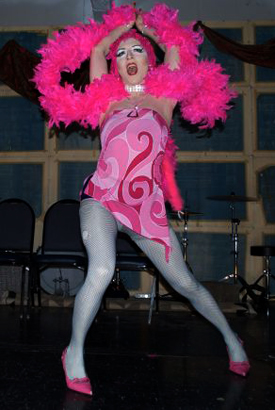 OT:
During your time at Pitt, you often studied the history of drag, tracing it back through the socio-economic
underpinnings of voguing (dance) in the late 80s, Susan
Sontag’s essay on camp in the 60s, all the way back to the writings of Oscar Wilde. How does this knowledge, if at all, effect how you approach a
performance? Is there anything you hope to accomplish through this combination of drag performance and
critical study?
OT:
During your time at Pitt, you often studied the history of drag, tracing it back through the socio-economic
underpinnings of voguing (dance) in the late 80s, Susan
Sontag’s essay on camp in the 60s, all the way back to the writings of Oscar Wilde. How does this knowledge, if at all, effect how you approach a
performance? Is there anything you hope to accomplish through this combination of drag performance and
critical study?
JM: Ah yes, some of my most pleasing and successful academic work was my investigation of drag that began with Oscar Wilde, who in turn planted several seeds of influence that ultimately bloomed and coalesced into a more modern understanding and image of how we view and discuss drag. However pleasing this work may have been, I don’t honestly believe that it helped to improve my drag. How I approach a performance? Maybe only slightly, in that I might consider the dimensions of what I’m performing i.e. not only performing gender, but perhaps class and other representations, too. There is always an essential disconnect between the worlds of tangible research/writing and the ethereal world of performance. My academic work improved through practice. The same applies to my drag; the more comfortable I become within my character and the better I know and develop Veronica, the better my performances become. Though this disconnect exists, I see my role as a drag performer as a unique opportunity to glean insight into an otherwise academically neglected cultural phenomenon.
OT: You and your partner in drag, Daniel Stuchel a.k.a. Dani Lamorte, recently began doing Drive-by Drag performances, where you show up to various public locations in the Pittsburgh area, do a number, and then leave without a trace. What was the impetus behind this type of performance? What kind of reception from the public do you hope to get/have gotten?
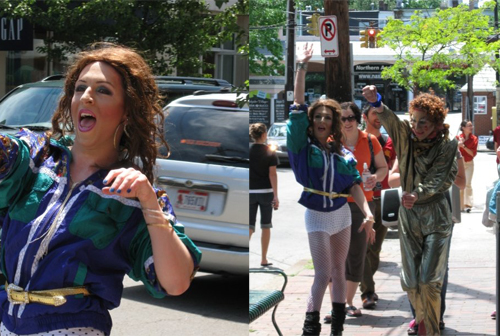 JM:
Drive-by-Drag was born out of a kind of frustration with the bar scene in Pittsburgh,
specifically the gay bar scene, and how a drag performer has to go about to be noticed. With that in mind, I
had been going through a particularly long dry spell in bookings, and had suggested to Dani(el) that we
should begin doing numbers anywhere we felt like it as a way to break free of the bar scene and create a
performance space that was new and challenging. Not only that, but when the walls of a gay bar are removed,
the presence of the audience becomes that much more alluring in its uncertainty. Dani and I have realized
that far contrary to the general expectation that drag would be treated in a hostile manner if leaked out
into the daylight amongst the more heterosexual crowd, that regular people are oftentimes thrilled and
surprised by drag when they encounter it. Aside from the occasional schizophrenic old man yelling at us to
be men, it seems that Drive-by-Drag brightens people’s days and raises consciousness. Lofty goals,
eh?
JM:
Drive-by-Drag was born out of a kind of frustration with the bar scene in Pittsburgh,
specifically the gay bar scene, and how a drag performer has to go about to be noticed. With that in mind, I
had been going through a particularly long dry spell in bookings, and had suggested to Dani(el) that we
should begin doing numbers anywhere we felt like it as a way to break free of the bar scene and create a
performance space that was new and challenging. Not only that, but when the walls of a gay bar are removed,
the presence of the audience becomes that much more alluring in its uncertainty. Dani and I have realized
that far contrary to the general expectation that drag would be treated in a hostile manner if leaked out
into the daylight amongst the more heterosexual crowd, that regular people are oftentimes thrilled and
surprised by drag when they encounter it. Aside from the occasional schizophrenic old man yelling at us to
be men, it seems that Drive-by-Drag brightens people’s days and raises consciousness. Lofty goals,
eh?
OT What can OT readers expect from you or your alter ego in the near future?
JM: As far as John knows, he’ll be in Pittsburgh for at least one more year working and preparing for graduate school. During that time, Veronica will most certainly still be around, causing chaos and joy wherever she sees fit. If she feels up for it, she might try to re-enter the bar scene and enter a few pageants, but I daresay Veronica now has some different aspirations. Her booking calendar is almost entirely wide open. Keep this in mind if anyone wants to see Veronica at his/her neighborhood book sale, grand opening, bar mitzvah, donkey show, or Open Thread event (hint hint).
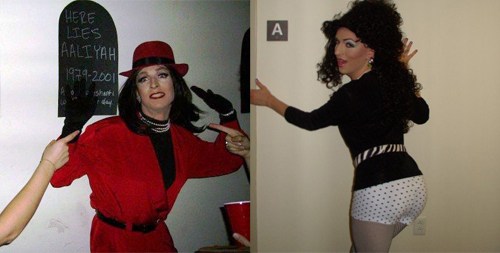

In Waynesburg, Pennsylvania (a little south of that other burgh) exists one of the indie film
community’s best kept secrets in the form of Happy
Cloud Pictures, a production company that has set out to prove that just because film is low budget does
not mean it has to also be low quality. Founded and maintained by the dynamically creative husband-wife duo of
Mike Watt and Amy Lynn Best 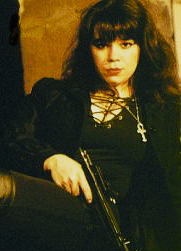 and
their mutual friend Bill Homan, Happy Cloud Pictures has produced a handful of movies that have screened
across the tri-state area. Since they were picked up for national distribution both at festivals and on DVD,
they have developed a small but growing fan base, and considering the quality of work they do, quite justly.
and
their mutual friend Bill Homan, Happy Cloud Pictures has produced a handful of movies that have screened
across the tri-state area. Since they were picked up for national distribution both at festivals and on DVD,
they have developed a small but growing fan base, and considering the quality of work they do, quite justly.
While the majority of the work thus far the Happy Cloud team has produced falls under the horror genre, the ingenuity and creative process that goes into each of their films often prevents them from being lumped with the usual “splat” style scary movie. This owes much to the writing of Mike Watt, who splits most of the creative duties with Amy Lynn Best. Watt’s the writer, she’s the actress—but they both produce and direct, and have shown proficiency for both. Certainly, there is no lack of skill on each movie set. But I digress; we were discussing Watt’s writing, and really, this is truly the foundation of the merits each film Happy Cloud Pictures has produced. The scripts are often acerbic, biting, and extremely clever, tackling the tropes of the genre and turning them on their heads. This is writing by someone who knows that horror has become too usual, and understands that, sometimes, the tongue-in-cheek is all we have left to provide a good scare. Watt often does exactly that: scare us while we are chuckling.
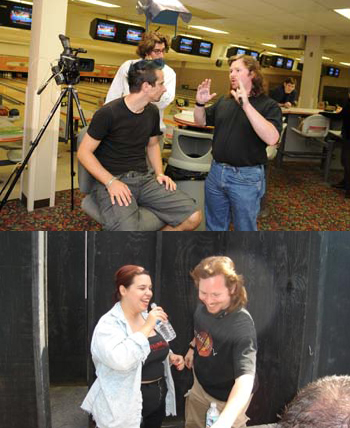 It’s no small wonder that Watt is skilled with words. In addition to his film career, he has
served as the editor and driving force of the nationally published film magazine Sirens of Cinema and has written two books of his own, the first being the novelization
of Happy Cloud’s first movie, The Resurrection Game, and the other being his recent collection of
short stories, Phobophobia. Both highlight his ability to craft a story in the most traditional
sense—and both are available for purchase at http://www.happycloudpictures.com.
It’s no small wonder that Watt is skilled with words. In addition to his film career, he has
served as the editor and driving force of the nationally published film magazine Sirens of Cinema and has written two books of his own, the first being the novelization
of Happy Cloud’s first movie, The Resurrection Game, and the other being his recent collection of
short stories, Phobophobia. Both highlight his ability to craft a story in the most traditional
sense—and both are available for purchase at http://www.happycloudpictures.com.
The aforementioned zombie survival piece, The Resurrection Game, was written and directed by Watt and starred Best. Combining elements of sci-fi, horror, and black comedy, Resurrection set the pace for the films to come, each building upon the last’s unconventional approach to horror genre staples, now Watt’s calling card. What followed were forays into such horror topics as werewolves (2002’s short Weregrrl), vampires (2007’s A Feast of Flesh), and even a slasher movie satire (2003’s Severe Injuries, which also marked Amy Lynn Best’s directorial debut, and remains one of this writer’s personal favorites of the Happy Cloud back catalog). Each film carries its own unique stamp and merits its own viewing.
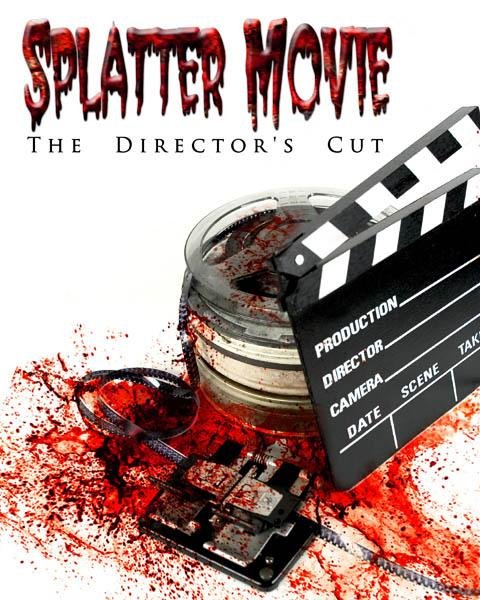
Given enough time, I would be inclined to go film by film and provide commentary for you, dear reader and Happy Cloud novice, but in the essence of brevity, I’d like to take the last few bits of my Open Thread space to highlight Happy Cloud’s most recent filmic endeavor, Splatter Movie: The Director’s Cut.
I have no qualms admitting I watched Splatter Movie three times. Once when it was being screened at the Cinema Wasteland Horror & Exploitation movie weekend in Cleveland, and twice when I had the screener in hand for this very article. It’s a compulsive little watch, and what it lacks in big Hollywood budget, it certainly makes up for in sheer creative willpower. Splatter Movie: The Director’s Cut can be described as one of the few meta-filmic films on the market.
What’s that mean, exactly?
Well, I’ll explain as best I can—though I feel it’s one of those movies that is best experienced personally, in the 90 minutes the audience is given. Splatter Movie takes place on the set of a movie, wherein a documentary crew is filming a “making of” documentary about a slasher flick being directed by a character played by Amy Lynn Best. Meanwhile, we as the audience know that there is an actual slasher stalking the film’s set and killing members of the cast and crew, thus ensuring actual scares and menace to those of us viewing at home. It seems very straightforward, but this is actually where it gets tricky. As the film wears on, we are viewing the film through the oscillating camera of the documentary, the film within a film’s cameras, and the audience’s eye (for lack of a better term.)
It becomes a delicate affair. How do we know when we are seeing the documentary? How do we know when we are seeing the truth? How do we know if the kill we just witnessed was in the movie that is being made or the movie we are watching? It seems like it would be confusing (and it can be), but Splatter Movie is never frustrating, and that is key to its success. I loved this movie because it was a challenge. It took on the notion of how reliant we as the audience can be on the idea of what a movie is supposed to be, and how we expect the camera to feed us what we expect to know. To me, Splatter Movie was exciting because it was fresh and original, and I don’t really get that all too often at the multiplex these days.
Of course, fans of traditional genre horror will like it too (At least I think so.) as it has just enough scares to keep you on your toes—not to mention appearances by some genre favorites, such as Debbie Rochon (a B-movie queen, and notable for her performances in several Troma movies) and Tom Sullivan (famed art director of Sam Raimi’s The Evil Dead, and one of the most pleasing performers in the film).
Essentially, I highly recommend this film, but even more so I recommend keeping your eyes on Happy Cloud Pictures, as their back catalog is fun, and if this most recent outing is any indication, they just keep getting better. In fact, their next feature, The Demon Divas of Damnation Lanes (a horror comedy set in a bowling lane wherein strikes are not the only shenanigans), is due out later this year and allegedly they are already working on their first non-horror film to follow that, pretty much indicating that when all is said and done, this Happy Cloud also has something of a silver lining.
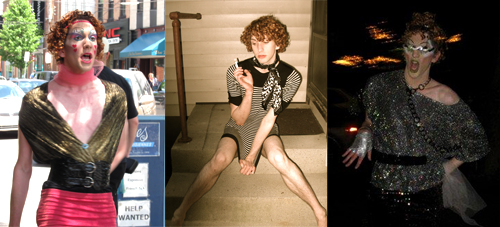
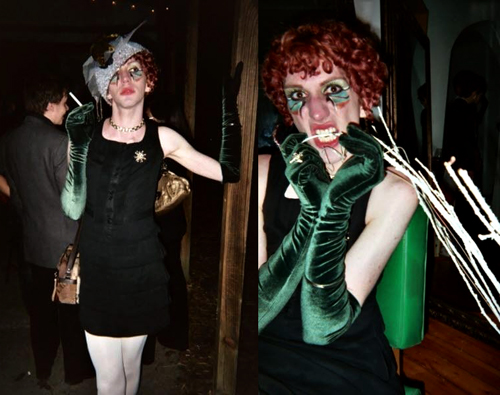
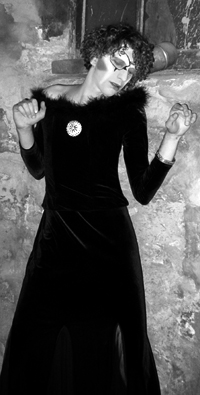 Daniel Stuchel,
a.k.a. Dani Lamorte, is a self-described radical, highly questionable queer, living off of gin and shoulder
pads in the great city of Pittsburgh. This native of Vandergrift, PA frequently turns trash into haute
couture, fashioning a busted chandelier into a glittering helmet or breathing new life into a sadly
abandoned, gold lamé tracksuit. You can catch Dani, along with drag partner and upcoming Featured Artist
Veronica Bleaus, terrorizing the town in a series of impromptu performances affectionately named Drive-by Drag. Be sure to check out their website
frequently to find out where they will be showing off their fancy selves next. For past performances, her
MySpace profile has enough pictures to keep you satiated until you can see Miss
Lamorte in the sequined flesh. I had Daniel/Dani answer a few questions about drag and growing up in Western
Pennsylvania, and here was what this hot mess had to say:
Daniel Stuchel,
a.k.a. Dani Lamorte, is a self-described radical, highly questionable queer, living off of gin and shoulder
pads in the great city of Pittsburgh. This native of Vandergrift, PA frequently turns trash into haute
couture, fashioning a busted chandelier into a glittering helmet or breathing new life into a sadly
abandoned, gold lamé tracksuit. You can catch Dani, along with drag partner and upcoming Featured Artist
Veronica Bleaus, terrorizing the town in a series of impromptu performances affectionately named Drive-by Drag. Be sure to check out their website
frequently to find out where they will be showing off their fancy selves next. For past performances, her
MySpace profile has enough pictures to keep you satiated until you can see Miss
Lamorte in the sequined flesh. I had Daniel/Dani answer a few questions about drag and growing up in Western
Pennsylvania, and here was what this hot mess had to say:
OT Blog: Your drag career started in 2004 when you came to the University of Pittsburgh to pursue your interests in languages, particularly French. What got you into drag? Are there any moments from your childhood that you look back on now and recognize as a build-up to your debut as Dani Lamorte?
Daniel Stuchel: As a child, playing dress-up was always my favorite game. I would wear a towel on my head and pretend it was long hair. My terrycloth locks were accessorized with a curtain dress, a pair of my mother’s heels, and the old-lady jewelry I acquired at yard sales. At the age of four, my mother said to me, “If you want to be a girl, I can take you to the doctor and he can do an operation to make you a girl.” She wasn’t serious, and I’ve always been happy being a boy, but I think it was apparent at an early age that I would never color inside the gender lines.
My drag career seems to be an outgrowth of my personality. I spend a great deal of time in my imagination, daydreaming away the hours. Fashion, make-up, dance, music, and performance are all passions of mine. It’s hard to say what got me into drag, but I think I’ve recognized it as a way to keep playing dress-up throughout adulthood, while giving an outlet to my creativity.
OT: How has your conception of drag changed since you started performing? Are there any common misconceptions that you have noticed that you would like to dispel?
DS: Drag is an increasingly blurry concept for me. Back at my debut, I firmly believed that drag had something to do with femininity, with looking like a woman. It was distinct and separate from the rest of my waking life and had unyielding rules and boundaries. The problem with thinking that way is that drag is a revolutionary art. By simply dressing up in drag, you are violating social norms and upsetting the organization of the world around you. When I realized this, the rules began to fall away. Nowadays, I find it nearly impossible to define drag and frequently question whether the performances I give count as drag.
Drag is the perfect mannequin. It has a few humanoid features and a completely naked body. I dress my drag-self up in the things that scare me, worry me, hurt me, or even just the desires I cannot express in my day-to-day life. Then I gaze at what I’ve made and do my best to understand. Once I understand, I use the power of that knowledge to search deeper and find the next thing that goes bump in the night. To me, drag is about making my daydreams become real and exploring the unknown.
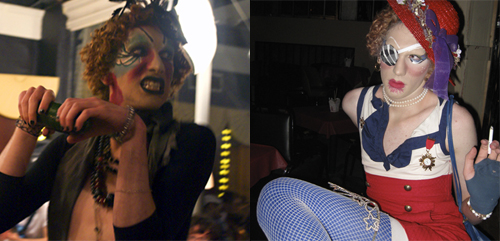
OT: Dani Lamorte’s drag style, and even your own everyday style, is androgynous with flair for the dramatic. Unlike what many are familiar with in terms of drag, you’ve developed a look that highlights both extremes of femininity and masculinity. What inspires your fashion and performance style? What do you personally find you are able to accomplish with androgyny that you could not following traditional gender norms?
DS: Clothing is one of my absolute favorite things. Getting dressed in the morning is like making a collage, taking pieces that jive with my mood and arranging them until I reach that moment where everything feels perfect.
My fashion and performance styles are both heavily influenced by my inner world, the bizarre daydreams and thoughts that strike me at random. As you can imagine, what inspires me changes on a regular basis. Right now, I’m terribly fascinated by the idea of thresholds (i.e. how much “girl clothing” do I need to wear for my gender to be called into question?) and intersections. Intersections have been a primary fixation of mine for a few weeks now - the idea of two objects headed on completely different courses meeting for a moment in time, thus coloring each others’ perception of the remaining journey. Of course, if you’d like a more standard answer, I would have to say that I’m influenced by my favorites in the fashion world - Christian Lacroix, Yves St. Laurent, and Albert Kriemler. All three play with overemphasized gender and androgyny.
Simply put, androgyny permits me to do whatever I please. Androgyny, by definition, is found in the murky waters of gender - you’re never sure what it contains or what it should look like. I like rampant possibilities and unlimited exploration. Gender norms are for people who aren’t curious.
OT: As an aside, you used to go by Lilith LaMorte when you first started out but now go by Dani Lamorte. What made you switch?
DS: Originally, I performed under the pseudonym Lilith LaMorte. This worked perfectly as I considered my drag persona to be separate from who I am on a day-to-day basis. With time, the blurring of some lines, and a lot of personal growth, the construct known as Lilith became obsolete and limiting. During many performances, I felt as though it was Daniel on stage and not some separate entity. For me, dressing up, slathering on paint (drag speak for make-up), and throwing myself on stage doesn’t require a separate persona or even a division between my day-to-day life and my stage-self.
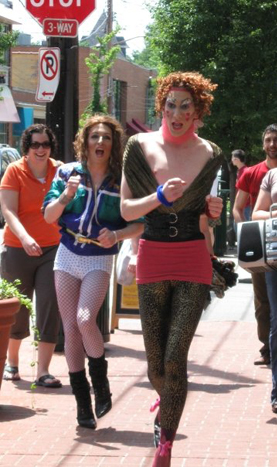
So, I kicked Lilith to the curb and adopted Dani - a shortened, androgynous version of my birth name. Lamorte has nice ring to it, so I kept it. Dani Lamorte is me – typing this response on my lunch break at work, doing the dishes when I get home, talking to my mom on the phone, and jogging down Walnut Street in a lamé track suit while the song “Two of Hearts” blasts out of a boombox and Veronica dances next to me. It’s all the same person, all the same adventure.
OT: Continuing with the issue of androgyny, I find that your drag is similar is many ways to the costuming and dress of the club kids of the late 80s and early 90s, of performance artists like Leigh Bowery who emphasize ridiculousness in gender, and, going even further into history and tradition, of side-show freaks like the Bearded Lady. There has always been a simultaneous fascination and repulsion towards these figures, these “freaks” within our society. What is your definition of freak and what does it mean to be one? What kind of response can one achieve from beneath this seemingly derogatory label?
DS: I’m flattered to be compared to Leigh Bowery! He was an absolute genius. I’ve always loved Leigh’s use of the disgusting, the unattractive and abhorrent. He saw them as interpretations of beauty. He was certainly a freak as I define the word. Freaks, to me, are people who defy culture at-large simply by being themselves, attracting a mixture of disdain and praise. Praise comes from a place of appreciation and identification, while disdain comes from fear and shock.
 Freak is only
derogatory if you want to be a follower, a wallflower, someone who blends into the scenery. To me, though,
being a freak is incredibly powerful as it demands the attention of the people around me and puts me in the
position to educate, explain, break down barriers, create, and share. I’ve always liked tarot cards
and, in particular, The Magician card; it represents an individual who harnesses the power of the world
around him and can evoke change. I would like to think that freaks, drag queens or no, are the magicians of
this world.
Freak is only
derogatory if you want to be a follower, a wallflower, someone who blends into the scenery. To me, though,
being a freak is incredibly powerful as it demands the attention of the people around me and puts me in the
position to educate, explain, break down barriers, create, and share. I’ve always liked tarot cards
and, in particular, The Magician card; it represents an individual who harnesses the power of the world
around him and can evoke change. I would like to think that freaks, drag queens or no, are the magicians of
this world.
OT: You and your partner in drag, John Musser a.k.a. Veronica Bleaus, recently began doing Drive-by Drag performances where you show up to various public locations in the Pittsburgh area, do a number, and then leave without a trace. What was the impetus behind this type of performance? What kind of reception from the public do you hope to get/have gotten?
DS: Drive by Drag was, in a way, a fantastic intersection! John and I are very different people, but we have moments when a singular idea resonates perfectly with both of us. We had toyed with the idea of giving performances in supermarkets, parks, and other random locations, but it never quite happened. When John approached me with the idea for Drive by Drag, as a series of performances throughout the city, I could hardly say no! I love the spontaneity and randomness of it all. Unlike most shows, we can’t control many of the elements of our stage; it presents new creative challenges and hurdles. I’m eating it up.
To date, the public has been curious, friendly, and completely stunned. More than anything, I think John and I both want to bring a little bit of unexpected art and excitement to the world around us. I feel we’ve been successful thus far.
OT: What can OT Blog readers expect from you or your alter ego in the near future?
DS: Oh, gosh! Well of course, you should expect more Drive by Drag. You never know where we’ll show up! I’ll also be performing at Veruca La’Pirhana’s birthday party at the Blue Moon in July. I would definitely encourage the readers to show up; I have something quite special planned.
Classical voice and music were my life for most of my childhood and teenage years, and I’m dying to re-explore them. I’ve taken up some musical endeavors, both solo and collaborative. In particular, I find atonal and experimental music enticing.
Life presents ceaseless opportunities to be creative, and I’m always interested in working with other artists and creative types. Got an idea? Give me a call!
 I have no problem admitting that when it comes to Messy
Magazine , I am certainly biased on their behalf. That said, this bias honestly has nothing to do with
the fact they published an article of mine in their Cleveland Film Guide, or that I went to college with one
of their founders—although, it doesn’t hurt. Truth is, I totally dig Messy Magazine because, above all else,
it is such a damn cool idea.
I have no problem admitting that when it comes to Messy
Magazine , I am certainly biased on their behalf. That said, this bias honestly has nothing to do with
the fact they published an article of mine in their Cleveland Film Guide, or that I went to college with one
of their founders—although, it doesn’t hurt. Truth is, I totally dig Messy Magazine because, above all else,
it is such a damn cool idea.
In essence, the Cleveland-based online magazine is doing for the Northeast Ohio art community what we here at Open Thread are doing for artists in the Pittsburgh and tri-state area: spreading the word.
Since its first issue in November 2008, Messy Magazine has challenged budding and established writers to craft articles on each issue’s predetermined theme, while at the same time finding fresh and unique ways to highlight all sorts of artsy goings-on in the Cleveland area. This devotion to giving exposure to artistic events led to the magazine becoming involved in this year’s Cleveland International Film Festival, for which they produced the aforementioned Cleveland Film Guide to help promote the event, and participated even more directly by sponsoring one of the films screened.
Messy Magazine is headed for big things, and since their mission grooves so well with ours here at OT, it makes sense for us to pay it forward and get the word out about this wonderful publication. I recently had the opportunity to talk to Vanessa Aron, business planner and founding member of Messy Magazine, about the publication’s history, their involvement with the film festival, and what’s in the future for all things Messy.
OT Blog: How did Messy Magazine get its start?
Vanessa Aron: Messy Magazine is a project that has been in planning for quite sometime. It really started with Lauren Kirk and Michael Stidham, who both attended Cleveland State University. They had several writing classes together and really became focused on creating something that would benefit the art community in Cleveland. They were really looking for an outlet for their creative expression. Lauren is a writer, and Michael is an amazing visual artist who also writes amazingly well. I am jealous of their skills!
Lauren and I both interned for the Cleveland Free Times, but during separate summers. We had a mutual acquaintance, and my involvement with the magazine came about simply through run-ins and conversations with her about our current professional states and about how changes could be made in the arts community of Cleveland. There is so much going on here; there are art galleries left and right and a ton of people creating a lot of interesting stuff. It’s a bit uncollected, though, and unless you’re knee-deep into the arts community, it’s easy to miss a lot of the goings-on in the city.
Professionally, both Lauren and I were in interesting situation. I had been laid off and I was looking for something I could focus on and would give me a sense of self-worth. Losing my job was strange because I am someone who really needs to have a packed schedule to get things done, and suddenly I had all this free time, and I was unsure how to fill my days.
The serious planning stages started in February after Lauren and I went out for drinks one evening. I arrived home that night, and I couldn’t sleep because the wheels in my head started turning after this lengthy conversation about Cleveland and art that night. So instead of sleeping, I created a business plan that really became the foundation of the magazine. I emailed it to Lauren the following morning and said, “This is what we’re doing,” and it’s been going ever since. We planned through spring and summer 2008, fine tuning this and that, creating a draft of the design of the magazine, etc.
I brought Genna Petrolla (MM’s marketer) on board with the magazine last July/August. Genna and I both worked at the company I was laid off from, and I knew she’d be perfect for our mission. She is amazingly talented, and our work strengths balance each other very well.
So our first issue came out in November 2008. And people started to take notice and we’ve been going ever since. We just distributed our fourth issue over Memorial Day weekend!
OT: Messy Magazine had some serious involvement in the Cleveland Film Festival this year, putting out not only the Film Guide, but you sponsored one of the films that was screened there. How did this partnership come about?
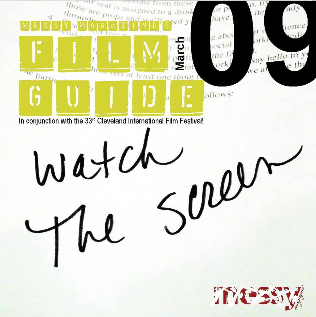 VA: The film festival was a f*cking blast, and it was so great being a part of all
the excitement. This was the biggest year ever for the
Cleveland International Film Festival. They broke attendance records on each day of the festival.
VA: The film festival was a f*cking blast, and it was so great being a part of all
the excitement. This was the biggest year ever for the
Cleveland International Film Festival. They broke attendance records on each day of the festival.
We were contacted by the Cleveland Film Society, the folks who put on the CIFF, sometime in late December, early January after they had checked out the first issue of our magazine. They thought we had a great positive outlook on the city and the arts community in Cleveland. From what I hear, there was a buzz around our magazine after our first issue, which was very cool.
We were excited when they contacted us. It was a huge deal for us only after putting out one issue. Our second issue came out the second week of January, a few days after our initial meeting with the CFS people. We decided to further our involvement with the CIFF by creating our own film guide. We shadowed the CFS crew, interviewed them, hung out in their office for a day, it was a lot of fun and they’re a great, tight group of people. Genna told me when I walked into their office I’d never want to leave, and she was so right.
The film guide was primarily, but not completely, devoted to the CIFF. We incorporated articles about the film community in and around Cleveland. The film community is HUGE here, but it’s not super known. We have the Cleveland Film Society, the Cleveland Film Commission, Cinematheque at Case Western Reserve University, the Cedar Lee Cult Film Series, Cinema Wasteland, the film school at Cleveland State University…it’s huge!
We were also fortunate to sponsor a film at the CIFF, An Alternative to Slitting Your Wrists. This was probably the perfect film for us to sponsor, as the documentary, as well as our magazine, were creations out of crises. Even more, our sponsored film was created by Cleveland natives, something we were very excited about. The film had several sold-out showings, which was great.
OT: Each of your issues seemingly has a theme, dictating the feel of that particular issue’s writings and direction. What are some of the prior themes you’ve had, what are some you hope to have in the future, and how do you and the MM team come up with what you want the focus of each issue to be?
VA: When we created the magazine, we were looking for something that would encompass an entire issue so we wouldn’t be a magazine filled with just random work. As the overseer of the artistic direction, I wanted more of a coffee table book than magazine style look. That’s why we don’t directly promote who is in the issue on the front cover.
I’m a visual person, and I love photos and the use of visual work. I try to incorporate just as many images and photos as written work into each issue. A lot of the photos are my own as well, so I feel like I am also expanding my creative horizons, because I’m always out and about snapping images of random things to incorporate into each issue and the design.
I think overall the theme is our way of holding creative control over the entire operation. We also believe the use of a theme can fuel more creativity and more great work.
The downfall with using a theme is that if it makes no sense, or if people don’t understand it, they either won’t submit something, or they just submit whatever. We will and do accept work from anyone, anywhere, theme-related or not, but we do try to push the use of the theme. We are learning and becoming more aware of how simplistic or complex a theme can be, and really it’s an issue by issue thing.
Our first theme was Mad at Monday. It was a fun first theme to start out with because everyone has something to say about Mondays and the beginning of the work week—or if you don’t have a job, what Mondays mean when you are out of work. We had some pretty humorous submissions, so it was a lot of fun to put together.
Our latest issue, Emerge and See, was to the Messy Magazine group the most important and I suppose the most emotionally invested theme yet. There is a lot going on worldwide, regionally through the rustbelt, and specifically in Cleveland. We are trying to change attitudes that cities like Cleveland, Pittsburgh, and Detroit are not dead; they just need to look around and realize what potential they have and change their attitudes. I think we are off to a great start. We see big things coming our way!
OT: On that same token, what would you like to see in the future for MM?
VA: This is the perfect time for that question. We are sort of in what I would call a resetting phase. We are currently in the process of collectively reviewing what the magazine is and what we want it to become. We are on the brink of some really cool changes, which will be for the better. We are in the process of becoming a quarterly magazine. We want to focus our energies toward each theme and issue much more than we can at this point. We really want to fuel the creative world around us and really show everyone that there are amazing full-time, part-time, and seasonal artists in this world that are not showing at the MoMA, the MOCA, or wherever. These people have real jobs and also have a creative side, so we want to better ourselves to better show off what we see. Stay tuned! Summer ‘09 is going to be Messy Magazine’s own Emerge and See.
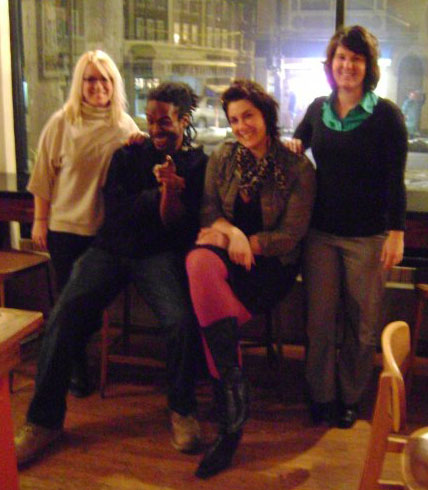
Many thanks to Messy Magazine and Vanessa for helping us out, and for getting the word out about nearby artists—a cause we can certainly support!
Check out their current issue, as well as back issues, at http://www.messymagazine.org/
Printwork-friendly Pittsburgh facility, AIR (Artists Image Resource), a non-profit artist-run organization, provides the necessary tools for personal, professional, traditional, and contemporary printmaking projects. AIR resources primarily include a Digital Imaging Lab, Lithography Shop, Intaglio Shop (etching), and additional workshops for papermaking and letterpress. Silk screening is a very popular component of AIR.
It has been home to more than 50 professional artists since its launch in 1996, and many of the past artists’ prints can be seen in room after room of the building—some can still be purchased. Local artist Ayanah Moor, is currently an Associate Professor of Art at Carnegie Mellon University who completed Alphabet A-Z in 2001, printwork which was completed at AIR. Each of the 26 screenprints (22”x30”) contained a definition exploring African-American slang. In 2000, John Thomas Pusateri, an Associate Printmaker at CMU, worked with AIR to complete a project that required relief, intaglio, litho, and screen.
Other records include prints from Patricia Villalobos-Echeverría, a transcultural artist who grew up in Nicaragua and addresses many of conflicts and natural disasters that Nicaraguans have faced. Villalobos uses personal texts and imagery to illustrate her themes of humanity and oppression.
But one need not be an established print artist to benefit from AIR. The facility provides public access to an Open Studio on Tuesday and Thursday evenings from 7-11 PM, which, for a nominal fee, grants guests the use of work space and printing materials for whatever the task at hand. Many regulars spend time at AIR completing flyer/poster projects, book-binding ventures and the occasional line of clothing. If you have the time—and the ink—anything’s possible. Silk screen sizes are available from 8”x10” to 40”x60”. Don’t fret if you forget any supplies: inks (acrylic & textile) and paper materials are available for a small price. Also, the managing artists at AIR are always willing to lend a hand to those new to the silk screening process. It’s also a pretty appealing sanctuary for local artists interested in shop rentals or a place to plan their next exhibition. Once you’re inside, there’s a good chance you’ll feel right at home.
In addition to its studio availability, AIR offers services ranging from Contract Printing to Project Consultation, which includes assistance with print-related academic projects within local schools and universities. AIR has worked with the Andy Warhol Museum on programs for Schenley High School on several occasions.
Artists Image Resource is located at 518 Foreland Street, on the North Side of Pittsburgh.
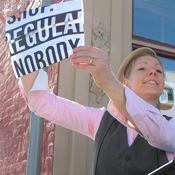 There’s a good chance you’ve already experienced native Pittsburgher Dawn Weleski’s work in
and around the city. Whether you’ve read her newspaper in the South Side, chatted with her over a tasty meal
served out of an RV, or stumbled upon an opera while waiting for the bus to arrive, Dawn’s work forces you
to rethink everyday experience. Her public works can be seen as social and political stress tests that cause
witnesses to question their typical social behaviors, as they disrupt the familiarity and comfort of the
everyday experience.
There’s a good chance you’ve already experienced native Pittsburgher Dawn Weleski’s work in
and around the city. Whether you’ve read her newspaper in the South Side, chatted with her over a tasty meal
served out of an RV, or stumbled upon an opera while waiting for the bus to arrive, Dawn’s work forces you
to rethink everyday experience. Her public works can be seen as social and political stress tests that cause
witnesses to question their typical social behaviors, as they disrupt the familiarity and comfort of the
everyday experience.
I asked Dawn to speak about her current projects, as well as a little about the experience she has had living here in the Pittsburgh area. To learn more about Dawn and her art, you can check out the Bus Stop Opera homepage. In the meantime, be on the lookout, because you just might be surprised to one day yourself a participant in her work.
OT Blog: You grew up just outside of Pittsburgh, I believe in Tarentum, before you became a student at Carnegie Mellon University, where you tried out several majors prior to landing in the School of Art. Since graduating this past December, you’ve decided to stay in the area, living in Regent Square. What is it about the city that keeps you here? What makes you a proud Pittsburgher?
Dawn Weleski: Yes, I’m from a town northeast of Tarentum called Natrona Heights. Tarentum was the first town in the mainland United States that struck oil, and Natrona was named from “Natrium,” the Latin word for salt. There is a huge salt mine near the mills that supplied the compound for the defense department’s creation of the first atomic bombs. The mills, mines, and industry in Natrona and Brackenridge employed all of my grandparents—and their parents—when they arrived from Poland. The women were employed in PPG (Pittsburgh Plate Glass) and ALCOA (Aluminum Company of America) factories. Even my dad paid his way through art school by working in night shifts in the mill after class. Living near this industry, hearing the stories of so many industry families, and being raised on the fruits of my ancestors’ labor with these materials makes me proud to be a Pittsburgher. It’s the positive, steady values of industry, though not the industry itself, that have sustained Pittsburgh and its people, especially in these tough economic times. Therefore, as a young professional, I can enjoy a low cost of living, burgeoning creative high and sub-cultures, decent employment opportunities, support for small for-profit and not-for-profit enterprises, and down-to-earth neighbors. Chicago, New York, and DC are only a drive away, as is some of the nation’s best hiking and camping.

OT: This past year you were awarded a grant to fund the Bus Stop Opera, an interdisciplinary, public performance work. You managed to successfully coordinate a group of mostly student actors, musicians, singers, and writers to perform songs from the point of view of everyday bus riders at stops across the city. Can you explain a little about the process leading up to these performances as well as the objectives behind the project?
DW: Bus Stop Opera places investigations of the everyday within the realm of the extraordinary and sublime. The operas agitate the routine private space within one’s public transportation ride through conversation and transform the everyday public space of bus stops around Pittsburgh through operatic performance of the same conversations. Basically, we have conversations with folks on buses and at bus stops, which are then, almost verbatim, transcribed into libretto. A composer then scores for the libretto, and, after a week of rehearsals, the songs are performed at Pittsburgh area bus stops with a full musical ensemble, including violin, cello, trombone, and bass. Once the 20 minute “operetta” is done, we hop on the next bus and re-perform the same songs at bus stops down the line, all throughout Pittsburgh. The operas accumulate mementos of the lives of Pittsburghers who utilize public transportation and frame the mundane as high art. The project is most successful when the public, engaged in conversation with our actors, are implicated as participants when the conversation begins to be sung. The public becomes part of the performance by meeting the gaze of the singers, and bus riders realize that they are on the “stage” and more readily relate and empathize with the narratives presented.
The project has several objectives: (1) to allow creative people from different disciplines to collaborate and, hopefully, create a richer product due to that collaboration; (2) to remind the public and art audiences alike that “Art” sometimes finds inspiration outside of one’s self, and, maybe, the product of that inspiration can be more relevant and successful if it’s placed back into the context from whence it came; (3) to question the notion of public and private, personal and general, at spaces, such as bus stops, that can be defined and are utilized as either. I’ve overheard so many cell phone conversations on the bus that maybe should have been kept private! Overall, we’ve performed along twenty different bus routes, written ten songs about ten distinct Pittsburghers, and engaged in hundreds of conversations with strangers. I’m most surprised when strangers, who normally wouldn’t speak to each other, bond over this odd experience happening within their space. We’ve had folks miss their buses to see the whole performance and nod or shout out in agreement upon hearing the song lyrics. Every part of the process is valuable, including the performance. When strangers become a part of a collective experience, the effect of the work is amplified.
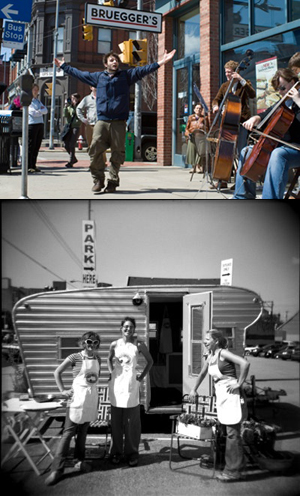 OT: Recent works like the Bus Stop Opera and RV Eatin’ [link
to RV Eatin’ in PG] (a collaboration with Laura Miller [link to Laura’s blog post] and Claire Hoch, in which
the three of you served homegrown, home-cooked meals out of an RV at various events and locations in
Pittsburgh in the hopes of generating good conversation) rely immensely on the element of public
interaction. With both of these works, the public plays a large role in their completion, and because of it,
there is a natural evolution that occurs. Can you speak about this angle of change and randomness within the
work, as well what it’s like to cede so much control to the public?
OT: Recent works like the Bus Stop Opera and RV Eatin’ [link
to RV Eatin’ in PG] (a collaboration with Laura Miller [link to Laura’s blog post] and Claire Hoch, in which
the three of you served homegrown, home-cooked meals out of an RV at various events and locations in
Pittsburgh in the hopes of generating good conversation) rely immensely on the element of public
interaction. With both of these works, the public plays a large role in their completion, and because of it,
there is a natural evolution that occurs. Can you speak about this angle of change and randomness within the
work, as well what it’s like to cede so much control to the public?
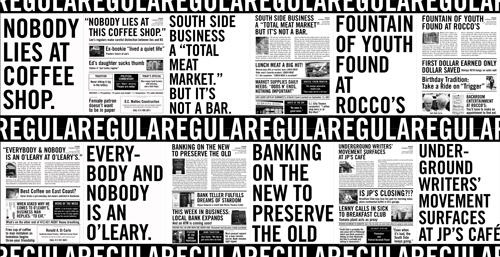
DW: I’m interested in creating artwork that lends agency to its audience. When I implicate my audience as a participant in the creation of the work, I’m lending them agency on the most basic level. Firstly, the can choose to participate. Secondly, based on initial boundaries that I create, my audience lends life to the format I present to them, whether through a community newspaper (”Regular”), family meals, or conversations on public transportation. Thirdly, because the audience becomes part creator/owner of the work, the art tends to have greater longevity, scope, and relevance to a greater whole. In some instances, the art can live beyond the artist. I find work that exists within the context which inspires it, exists for the most appropriate time and audience, whether for a split second or generations. I don’t create all of my work under this auspice, as different messages and subjects require different methods and media. However, even ancient media, such as fresco and egg tempera, were created to convey messages to their audience that would educate and prescribe meaning. Historically, religious icons and altar pieces, as well as public murals depicting social controversy and historical events, qualified objects and images as conduits of dramaturgical and ritualistic metanoia. My work reasserts the necessity for the public to devise its own social penance and cultural transformations.
OT: What can OT Blog readers expect to see from you in the future?
DW: Starting May 8, Claire Hoch and I will have a piece in the Mattress Factory “Gestures” show. We’re building a 12 foot silo that will sit outside of the annex space that acts as a vending machine for capsulated native seeds and discusses the communal agricultural history of the area. The silo, accessible during non-gallery hours, encourages the public to reclaim the “Commons” of the North Side by planting in sidewalk areas zoned by the city for trees. Additionally, the public that enters the gallery space will have a chance to drop the capsules into the silo via a long pipe. The public will fill, and the public will vend. Later that month, Bus Stop Opera is traveling to New York City to perform as part of HomeBase [link: www.homebaseproject.com], a residency and exhibition exploring the notion of home. Hopefully, New York City’s bus riders are just as engaging as Pittsburgh’s. We’re excited to see what will come of the performances in a different city and are considering touring to cities around America.
 I’ve known Emilia
Edwards for a while now, having spent long hours in the studio alongside her during our time at
Carnegie Mellon University as art students. I’ve watched her work develop exponentially over the years and
I’m always excited to see what she has been up to. She will so often have something new and nasty to show,
whether it be the baby octopi she is using to print with or the latest issue of a muscle magazine she’s
chopping up into a collage.
I’ve known Emilia
Edwards for a while now, having spent long hours in the studio alongside her during our time at
Carnegie Mellon University as art students. I’ve watched her work develop exponentially over the years and
I’m always excited to see what she has been up to. She will so often have something new and nasty to show,
whether it be the baby octopi she is using to print with or the latest issue of a muscle magazine she’s
chopping up into a collage.
In addition to being a great artist, she’s also a fan of America’s Next Top Model, which only makes her more appealing (at least to me). I asked her a few questions about her work and how Pittsburgh has been treating her.
Here’s what she had to say:
OT Blog: You came to Pittsburgh in the summer of 2004 to begin an undergraduate degree in Fine Art at Carnegie Mellon University. Since graduating in May of last year, you decided to stick around. What about the city made you want to stay? What makes is an ideal place for young artists?
Emilia Edwards: I just like it here. It’s a nice place to live. There’s always something going on, and everybody is welcome everywhere.
I moved to Pittsburgh when I was 18 from Albuquerque, New Mexico. I knew next to nothing about the city, or even the state of Pennsylvania. I hated Pittsburgh when I first moved here. I was used to sunny weather and a grid. Pittsburgh was, at first, dreary and confusing but after living here for a while I began to learn more about the city and discover its charms.
Pittsburgh is an interesting place to be a young artist because there are opportunities available to everyone here that would be hard to come by in a larger city. After living here for five years I have far more experience showing my work than I would if I lived in a place where exhibition space is more exclusive. Also, it is entirely possible to make something creative happen from scratch here.
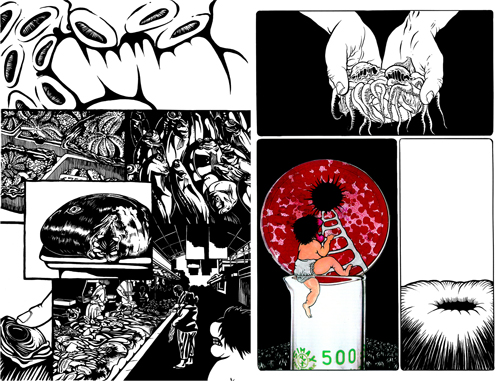
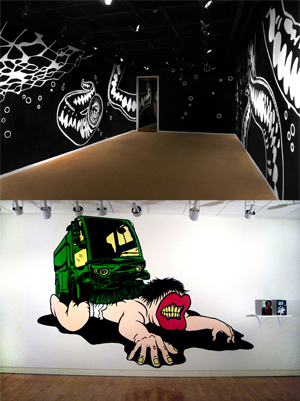 OT: Your work often deals with the grotesque, be it depictions of
rotting meat, bulging bodybuilders, ugly babies, or serpentine cryptids. Where do you think the inspiration
for much of this imagery comes from?
OT: Your work often deals with the grotesque, be it depictions of
rotting meat, bulging bodybuilders, ugly babies, or serpentine cryptids. Where do you think the inspiration
for much of this imagery comes from?
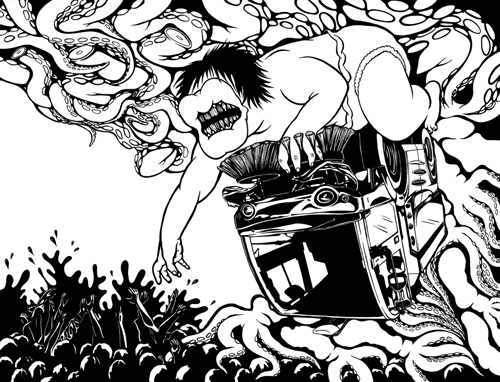
EE: I’ve always been fascinated by twisted and shocking images. My interest in horror movies and comic books began at a young age and continues to influence my art. Sea creatures are a recurring theme in my work. I like drawing ocean life because the result is usually part dinosaur, part alien, and part monster. Many of the images in my work are sourced from the pictures in medical journals, bodybuilding magazines, food magazines, Discovery Health shows about plastic surgery, the meat section in supermarkets, aquariums, and my own photography. I collage together ideas from photos and diagrams. I’m usually striving for a kind of ugly elegance in my work.
OT: Has anything in Pittsburgh particularly piqued your interest in the putrid and gross?
EE: I actually think Pittsburgh has contributed a certain beauty to my work that I wouldn’t find elsewhere. I have used drawings of Pittsburgh and several other industrial cities (Detroit, Bilbao and Frankfurt to name a few) as backdrops for my comics. The dramatic cityscape is an ideal setting for a fantastical narrative to take place.
OT: You were recently chosen by the arts organization Creative Time for their web project Creative Time Comics, where artists are invited to create a one-page web comic meant to address the issues facing our world. How did you get involved with them and what can we expect to see?
EE: I became involved with Creative Time through a former visiting professor at Carnegie Mellon. Christopher Sperandio was asked to contribute a page to the project and thought my work would fit well with the web format and content. From there CT contacted me and asked if I would contribute a page about something relating to “here and now”.
My page goes up June 1st at http://creativetime.org/comics. I am currently drawing a segment of a narrative about a deformed frog that lives in black water. It’s about the environment but the tone is not moral-driven. It’s a story about a toxic place and its inhabitants.
OT: What else can we look forward to from Emilia Edwards?
EE: I’m moving to Providence in July to start a graduate degree at Rhode Island School of Design. Until then I have a few projects lined up. I currently have a drawing on view in A Beckoning Country: Art and Objects of the Champlain Valley at the University of Vermont’s Fleming Museum. The piece is a preparatory drawing for Champy, a wall painting featuring Lake Champlain’s resident monster. My contribution to the Creative Time Comics project will go up in June. I am also working on some new ideas for giant wall art.
If you’re into inflammatory comments and scathing professional commentary, then an afternoon spent reading film reviews for the locally produced Gone the Way of Flesh will do your body good. Based on what I can tell, most critics think the film is poorly made, incoherent, and unwatchable schlock (though, in this writer’s eyes a little schlock never hurt anyone), but to get the whole picture of this little movie, we must first take a moment to learn about a band.
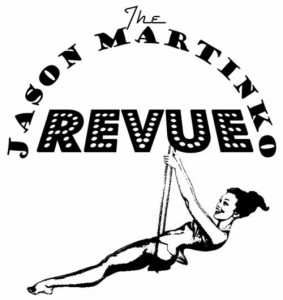
The band in question is a Pittsburgh based outfit going by the name of The Jason Martinko Revue (fronted, not surprisingly, by the multi-talented Jason Martinko), a band that takes classic ‘50s drive-in era rock and melds it with a swing/surf-punk sensibility to create a sound equally fresh and nostalgic. Formed in 1999, and performing (according to their website) “in countless seedy bars & roadhouses,” the band achieved a moderate level of success in 2003 when they released a self-titled album that had a modest number of sales. It was also around this time they came up with an extremely innovative way to promote their band: writing a movie.
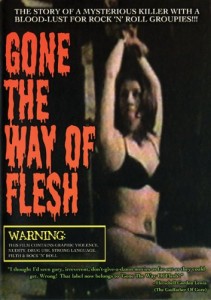
That movie, of course, became Gone the Way of Flesh, a tale of a killer that was stalking women at rock concerts, kidnapping them, and visiting unspeakable tortures upon the groupies with a maniacal zest usually reserved for screen villains and Fox News correspondents. (Guess who portrayed the band in the film.)
Taken on its own, the film seemingly has plenty of faults, but when viewed as part of
an inclusive multimedia experience, Gone the Way of Flesh takes on a truly engaging and fun
perspective. (And it certainly has become such an experience: the band recently screened the movie at the
Oaks Theatre in Oakmont, Pennsylvania—and immediately played a live set afterwards.)
 With the torture-oriented subgenre of horror
becoming increasingly popular in recent years (think Saw or Hostel), and its audience
growing larger and larger, the fact that Martinko and Co. tapped into this filmic subculture was ingenious,
helping to push their music past the bar scene that can trap so many local bands. Not only that, the film
itself has become something of a minor cult favorite, going so far as getting a glowing endorsement from the
godfather of gore himself, Herschell Gordon Lewis.
With the torture-oriented subgenre of horror
becoming increasingly popular in recent years (think Saw or Hostel), and its audience
growing larger and larger, the fact that Martinko and Co. tapped into this filmic subculture was ingenious,
helping to push their music past the bar scene that can trap so many local bands. Not only that, the film
itself has become something of a minor cult favorite, going so far as getting a glowing endorsement from the
godfather of gore himself, Herschell Gordon Lewis.
“I thought I’d seen gory, irreverent, don’t-give-a-damn movies as far out as they could get. Wrong! That label now belongs to GONE THE WAY OF FLESH” – it’s right there on the DVD box. As far as the horror industry goes, it’s the seal of bloody approval.
Following the film’s 2007 release, the Jason Martinko Revue showed little sign of slowing down, releasing a new album, “Damaged Goods” (which, coincidentally, features a song titled “Gone the Way of Flesh”) and recently announced that their production company, the aptly named Cut’N’Run Productions, is already at work on creating a sequel, tentatively titled Gone the Way of Flesh II: Fresh Bloody Flesh.
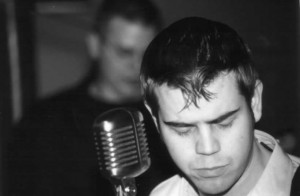 So
critics can say what they like, but when considering the innovative route the Jason Martinko Revue has taken
in getting their music to the world, I can’t help but applaud their efforts. Whether they are getting
screams from fans at their concerts or screams of terror in the theaters, I maintain that they are a bloody
good time.
So
critics can say what they like, but when considering the innovative route the Jason Martinko Revue has taken
in getting their music to the world, I can’t help but applaud their efforts. Whether they are getting
screams from fans at their concerts or screams of terror in the theaters, I maintain that they are a bloody
good time.